
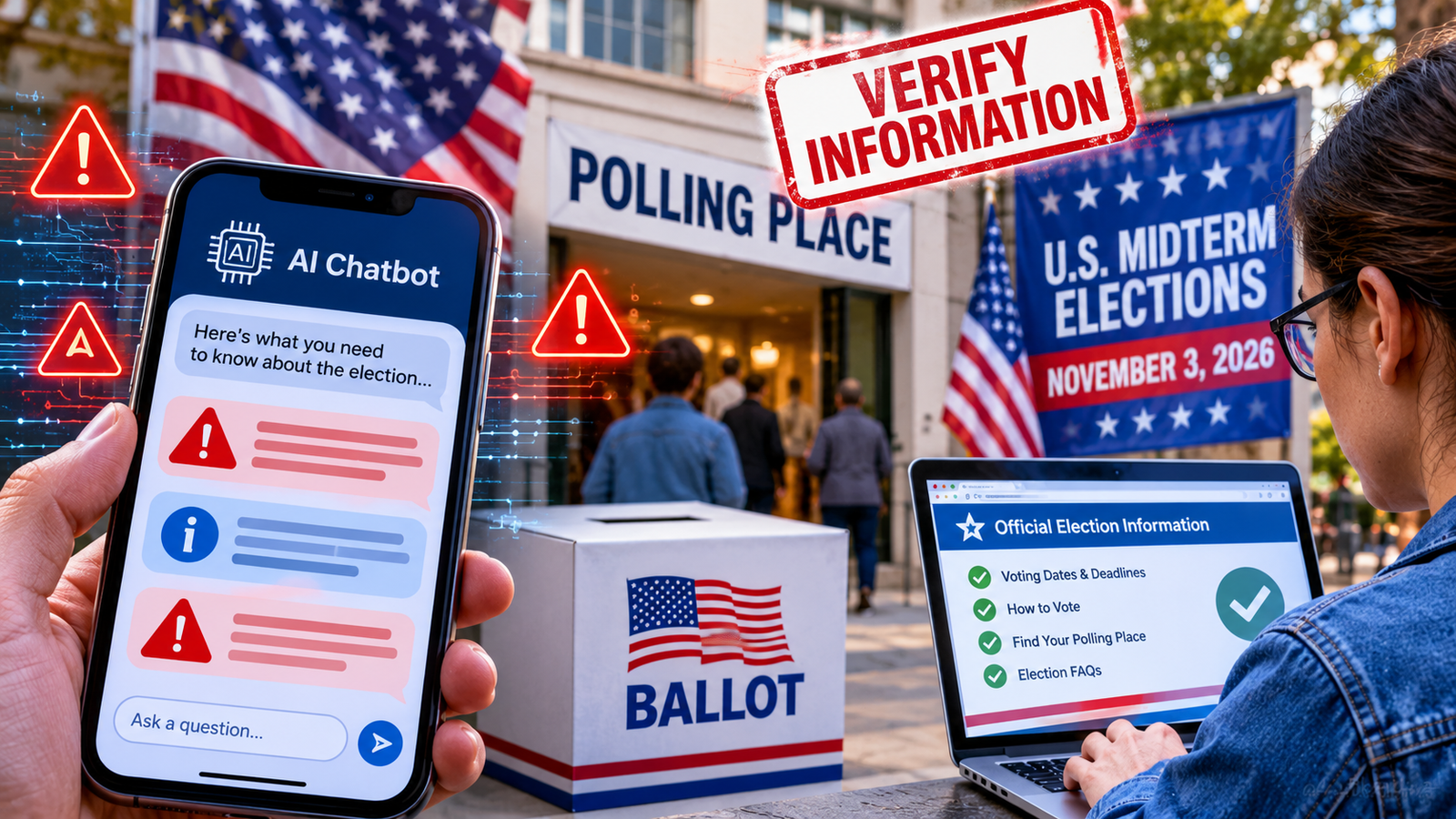
With the US midterm elections approaching on November 3, artificial intelligence chatbots are facing growing scrutiny over the accuracy of the political and voting information they provide.
Researchers say some popular AI tools have given misleading voting instructions, confused political candidates and repeated false claims circulating online. The findings raise concerns about voters relying on chatbots for information during a closely watched election.
The issue is particularly important because millions of Americans are increasingly using AI tools to research candidates, understand political issues and check claims they encounter on social media.
Study Finds Errors in AI Election Answers
A study by Forum AI, a company that evaluates artificial intelligence models, found that almost 40% of chatbot answers to election-related questions contained at least one factual error.
According to an AFP report published on November 1, researchers tested eight AI models and found problems involving candidate information and voting procedures.
In one example, a chatbot incorrectly attributed a former school superintendent role to Representative Don Davis of North Carolina, confusing him with another person.
Researchers also identified mistakes involving voting deadlines. When Google’s Gemini 3.6 Flash was asked about voting in Pennsylvania, it reportedly gave November 3 as the deadline to request a mail-in ballot, even though the actual deadline had passed a week earlier.
Such errors can have real consequences. A misleading answer about a candidate may confuse voters, while an incorrect deadline could prevent someone from completing the voting process on time.
Why AI Chatbots Can Give Wrong Election Information
AI chatbots generate answers using information learned from large datasets and, in some cases, material retrieved from the internet.
The problem is that not every online source is reliable or up to date.
Election information changes frequently. Candidate lists, polling locations, registration rules and mail-in ballot deadlines can differ by state and sometimes by county.
A chatbot that relies on an outdated webpage or an unreliable source may produce an answer that sounds confident but is factually wrong.
Researchers also warned that some AI tools cited low-quality online material, including Reddit discussions, when responding to political questions.
This makes source verification particularly important during election periods.
False Claims and Foreign Disinformation Add to the Risk
The concerns extend beyond ordinary factual mistakes.
Researchers have also warned that AI systems can repeat false allegations and misleading content associated with foreign influence operations.
AFP reported that fact-checkers had debunked an AI-altered video in late October that appeared to show a former student of Texas Senate candidate James Talarico making a sexual misconduct allegation.
The allegation was unfounded and showed signs associated with a possible Russian disinformation campaign.
NewsGuard, a misinformation watchdog, said several AI tools repeated the false claim when prompted about it.
This illustrates a wider problem: false information can spread across websites and social platforms before being repeated by an AI system as though it were credible.
However, repeating a false claim does not by itself establish who created or coordinated the original content.
More Americans Are Turning to AI for Election Information
The growing use of AI during elections is supported by recent survey findings.
A report by the National Conference on Citizenship, developed with researchers at The Carter Center, found that the share of Americans who had used an AI chat program to learn about candidates rose from 14% in early October to 25% in mid-October.
The survey also found that 40% had used AI for at least one election-related task by the second survey period, including checking election stories or finding out how to vote.
Yet trust remains limited.
Only around one in five respondents said they trusted AI systems a great deal or quite a bit to provide unbiased information about candidates.
The findings reveal a gap between adoption and confidence: people are increasingly using AI, but many remain uncertain about whether its answers can be trusted.
What Are Technology Companies Doing?
Technology companies have introduced safeguards intended to reduce misleading election information.
Google has said it has quality and policy protections for election-related AI responses. Microsoft has also said that its Copilot responses can be updated as more reliable information becomes available.
But researchers argue that stronger transparency, regular testing and better source verification are needed.
The Institute for Strategic Dialogue’s October 2026 report on US election platform preparedness also raised concerns about limited transparency around AI integrations and how platforms test their election-related safeguards.
The challenge is not limited to chatbots. AI-generated images, videos and audio can also make fabricated political claims appear convincing.
How Voters Can Protect Themselves
Voters do not need to avoid AI tools completely, but they should not treat a chatbot as the final authority on election procedures.
A few simple checks can reduce the risk of acting on incorrect information:
- Check official election websites: Confirm registration, polling locations and voting deadlines through the relevant state or local election office.
- Verify candidate details: Use official campaign websites and election authority records rather than relying on a chatbot’s summary.
- Check the original source: If an AI response cites a news report or study, open the source and confirm that it supports the claim.
- Be careful with viral videos: Look for independent fact-checks before sharing sensational political content.
- Do not rely on one answer: For important voting information, compare the chatbot’s response with an official source.
In the United States, voters can use the relevant state election office website or the official federal voting information resource, Vote.gov, to check registration and voting guidance.
Why This Matters Beyond the United States
The issue is not unique to American politics.
As AI tools become part of everyday internet use, voters in other countries may also turn to chatbots for information about elections, political parties and public policy.
The US midterms provide an important test of how well these systems handle time-sensitive political questions in a high-pressure environment.
The results could influence how technology companies design election safeguards before future national votes in Europe, Asia and elsewhere.
The Bigger Picture
AI can help people understand complicated political issues and find information more quickly. But the latest findings show that speed and convenience do not guarantee accuracy.
During an election, a wrong answer about a candidate or voting deadline can have consequences beyond an ordinary search mistake.
The challenge for technology companies is to make AI systems more transparent, reliable and careful when answering questions that affect democratic participation.
For voters, the safest approach is simple: use AI as a starting point, but verify important election information with official sources before acting on it.
This report reflects information available as of November 1, 2026. Election rules and deadlines vary by state and may change. Readers should confirm details with their local election authorities.
Sources
- AFP – AI chatbots face scrutiny over US election falsehoods
- The Washington Post – Chatbots make serious errors in voter guides
- Institute for Strategic Dialogue – Big Tech election preparedness report