
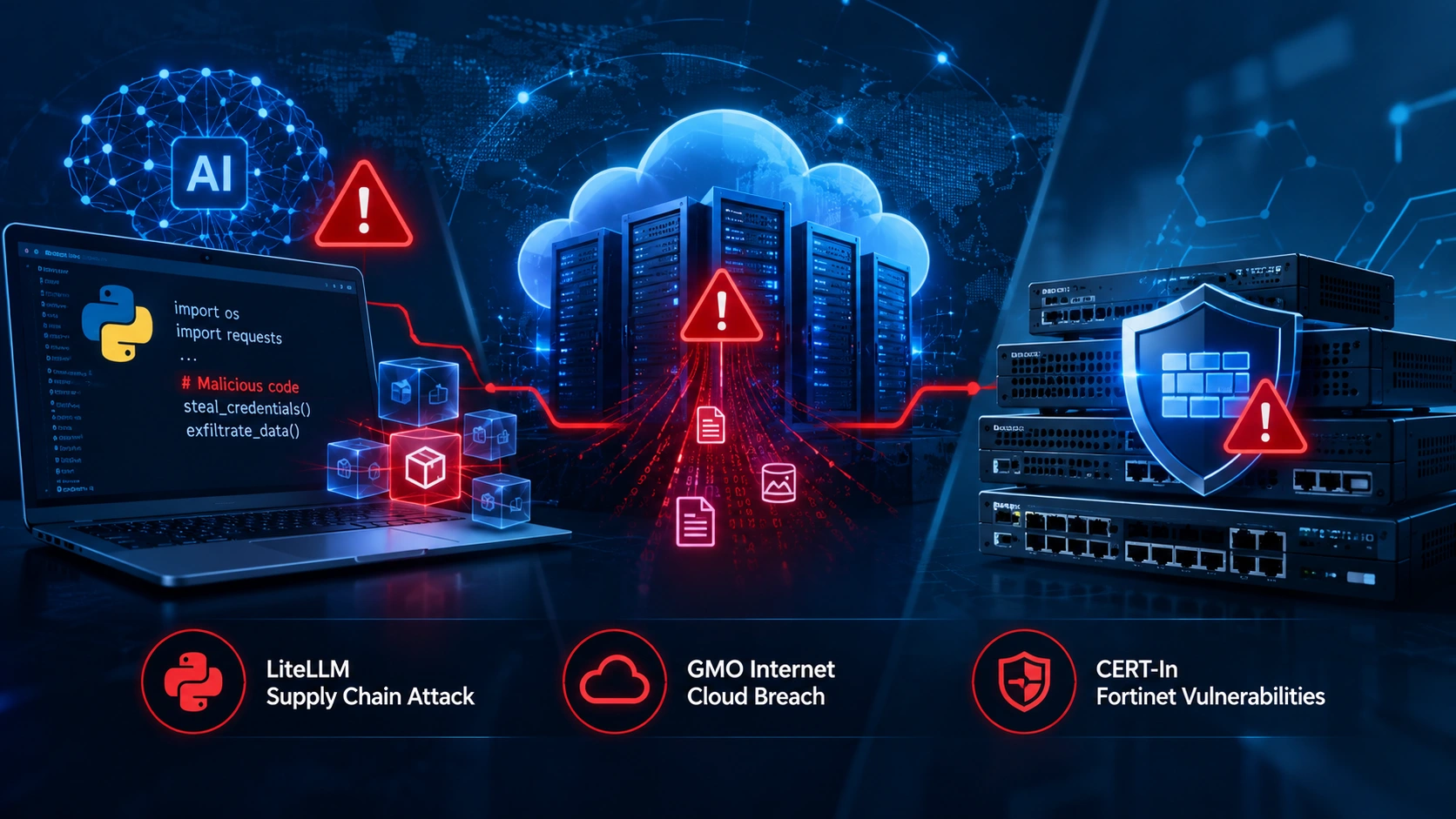
Latest cybersecurity developments: the LiteLLM supply-chain compromise, GMO Internet cloud data breach, and CERT-In’s urgent Fortinet vulnerability warning.
Cybersecurity Alert: AI Supply-Chain Attack, Cloud Data Breach and Fortinet Vulnerabilities Raise Global Security Concerns
Date: October 27, 2026
Category: Cybersecurity / Technology
Byline: Cybersecurity News Desk
Three Cybersecurity Incidents Highlight Growing Risks for Businesses and Cloud Users
Organizations worldwide are facing renewed cybersecurity concerns following three significant developments: a supply-chain compromise involving the LiteLLM AI software package, a confirmed data breach affecting GMO Internet’s Onamae.com Desktop Cloud service in Japan, and an urgent security warning from India’s Computer Emergency Response Team (CERT-In) concerning multiple vulnerabilities in Fortinet products.
Although the incidents are separate and there is no evidence linking them to a single campaign, together they demonstrate how attackers can target different layers of modern digital infrastructure—from software dependencies and cloud-hosted environments to network security appliances.
The developments also highlight a growing challenge for security teams: organizations must not only prevent unauthorized access but also respond quickly when trusted software or critical infrastructure is found to be vulnerable.
1. LiteLLM Supply-Chain Attack Raises Concerns Over AI Software Security
One of the major developments involves LiteLLM, a Python-based software development kit and proxy used to connect applications with different large language model (LLM) providers.
According to Microsoft Security Research and a CERT-In advisory, the LiteLLM 1.107.0 release was compromised and published through the Python Package Index (PyPI) on October 21, 2026. Reports also identified potentially compromised container images distributed through GitHub Container Registry and Docker Hub.
The malicious package reportedly included files designed to execute code during Python interpreter startup. This meant that, in affected environments, the malicious code could run when Python started—even if an application did not explicitly import or actively use LiteLLM.
The malicious components were designed to collect sensitive information accessible to the affected environment. Potential targets included developer credentials, cloud access details, browser-related data, SSH material, environment variables, and AI service credentials.
This is particularly concerning because AI gateways and development environments may hold API keys, database connection details, cloud credentials, and other secrets needed to operate production systems.
Microsoft cautioned that simply removing the LiteLLM application directory might not be sufficient to clean an affected environment. Organizations need to investigate the complete Python environment, rebuild affected systems from verified artifacts, and rotate credentials that may have been exposed.
Recommended response: Organizations should identify installations and container images associated with LiteLLM 1.107.0, isolate affected environments, investigate using trusted tools, rebuild where necessary, and revoke or rotate potentially exposed credentials from a clean system.
Sources: Microsoft Security Research and CERT-In advisory.
2. GMO Internet Confirms Customer Information Was Taken in Cloud-Service Breach
A separate incident has affected Onamae.com Desktop Cloud, a service operated by Japan-based GMO Internet.
In its October 21 announcement, the company said malicious programs had been installed in some customer server environments and that 26,739 servers were potentially affected. At that stage, the company had not confirmed a leak of customer information.
However, in an updated announcement dated October 24, GMO Internet confirmed that customer information had been taken outside the company. The company also said some customers had reported transactions in their trading accounts that they did not recognize.
The company stated that the investigation had identified security vulnerabilities in the service’s systems and unauthorized access. It said it was taking protective measures, including cutting network connections to affected systems and working with relevant authorities and related companies.
The incident illustrates the potential consequences of a cloud infrastructure compromise. Information stored on affected servers may be exposed, and credentials or sessions accessible from those environments may create additional risks for customers and connected services.
GMO Internet urged customers to remain alert to suspicious communications and follow official updates. Customers who may have stored passwords or authentication credentials in affected environments should change them and avoid reusing the same passwords elsewhere.
The company has also announced compensation measures for eligible customers and said it would continue investigating the incident.
Recommended response: Cloud customers should review official notices from their service provider, change potentially exposed credentials, revoke suspicious or active sessions where possible, check financial and account activity, and treat unexpected emails or calls related to the incident with caution.
Source: GMO Internet’s October 24 update.
3. CERT-In Flags Multiple Fortinet Vulnerabilities and Urges Urgent Patching
India’s CERT-In issued advisory CIAD-2026-0054 on October 24, warning of multiple vulnerabilities affecting Fortinet products.
The advisory covers several widely used security and network-management products, including FortiOS, FortiManager, FortiMail, FortiAuthenticator, and FortiAnalyzer. Fortinet has released security updates addressing critical- and high-severity vulnerabilities.
In an October 21 security blog, Fortinet explained that its security testing programme had used advanced AI models to help identify weaknesses in its products. The company also warned that similar AI capabilities could help attackers analyze patches, identify weaknesses, and combine vulnerabilities into more serious attack paths.
The issue is not limited to identifying vulnerabilities. Once a security update becomes available, attackers may examine the changes to understand what has been fixed and search for systems that have not yet been updated. This can increase pressure on organizations to patch exposed systems promptly.
Fortinet has published fixed software versions for affected product branches. For example, its published guidance lists FortiOS 7.6.8 or later for the affected 7.6 branch and FortiManager 7.6.8 or later for the affected 7.6 branch. Administrators must check the complete vendor guidance for the exact product and software branch they operate rather than applying a version intended for a different branch.
CERT-In recommends prioritizing internet-facing systems, backing up configurations before upgrades, restricting administrative interfaces, enforcing multi-factor authentication, and keeping management systems off the public internet wherever possible.
Detailed CVE identifiers and CVSS scores were scheduled for publication through Fortinet’s PSIRT process on November 10, 2026, according to the CERT-In advisory. Organizations should not wait for that date before applying the relevant fixes already made available.
Recommended response: IT teams should inventory their Fortinet devices, identify affected versions, install the appropriate fixed releases, restrict HTTPS and SSH administration to trusted addresses, and review logs for unusual administrative access or configuration changes.
Sources: CERT-In Fortinet advisory and Fortinet’s security update announcement.
What These Three Incidents Mean for Cybersecurity
These incidents involve different technologies and organizations, but they point to three important areas of cybersecurity risk.
First, trusted software can become an attack vector. The LiteLLM incident demonstrates why organizations must verify software provenance, monitor dependencies, and avoid assuming that a package is safe simply because it comes from a familiar ecosystem.
Second, cloud infrastructure requires continuous protection. The GMO Internet breach shows that vulnerabilities in a service provider’s environment can have consequences for customers whose systems and information depend on that service.
Third, security appliances need prompt maintenance. The Fortinet warning reinforces the importance of applying vendor fixes quickly, especially on internet-facing systems and management interfaces.
Organizations should also review how credentials are stored and accessed. Long-lived API keys, reusable passwords, overly permissive cloud identities, and exposed administrative interfaces can increase the potential impact of a successful intrusion.
Essential Cybersecurity Steps for Organizations
Security teams and business owners should consider the following actions:
- Audit software dependencies: Identify vulnerable or compromised packages, check package and container provenance, and use verified artifacts.
- Rotate exposed secrets: Revoke or replace potentially compromised API keys, cloud credentials, developer tokens, and other authentication material from a trusted environment.
- Patch critical infrastructure: Apply the correct vendor fixes for Fortinet products and other internet-facing systems.
- Restrict administrative access: Keep management interfaces private, use VPN or other controlled access methods, and enforce multi-factor authentication.
- Review cloud security: Check access logs, account activity, server integrity, and unusual financial or administrative transactions.
- Prepare for incident response: Maintain tested backups, an inventory of critical assets, and a documented procedure for isolating affected systems.
- Monitor official advisories: Follow CERT-In, relevant vendors, and trusted security researchers for verified updates.
Conclusion
The LiteLLM supply-chain compromise, the GMO Internet cloud breach, and CERT-In’s Fortinet warning underline the need for stronger security across the entire technology stack.
As organizations adopt AI tools, cloud services, and interconnected network infrastructure, a single weakness in a trusted component can expose sensitive credentials or disrupt important services. Rapid patching, careful software verification, restricted access, and disciplined incident response remain essential.
For organizations potentially affected by these developments, the priority is to verify exposure, follow official remediation guidance, and act on confirmed risks rather than rely on assumptions.