
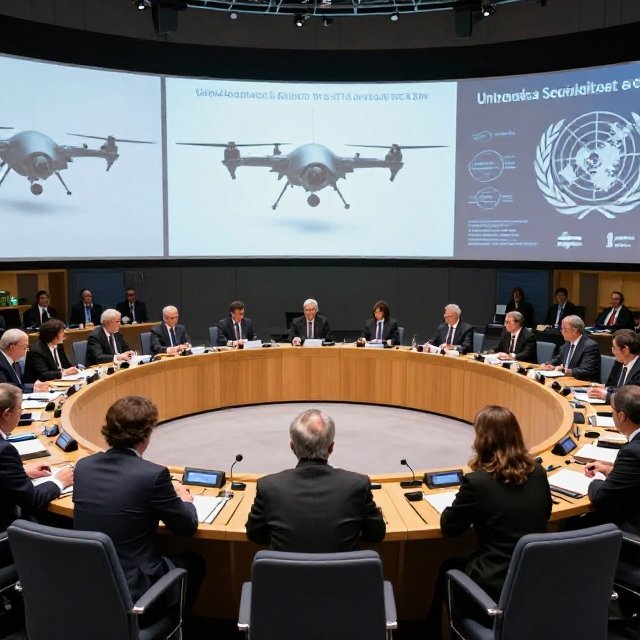
GENEVA, November 16, 2026 — Governments are facing a renewed test of how international law should deal with weapons that can identify and attack targets with limited or no direct human intervention. A United Nations-hosted meeting in Geneva is considering whether to begin negotiations on rules for lethal autonomous weapons systems, but major military powers remain divided over the form those rules should take.
The debate is not simply about futuristic robots. It concerns increasingly capable drones, automated targeting systems and other military technologies that may make life-and-death decisions at machine speed. The central question is how to ensure that people remain meaningfully responsible for the use of force.
Why the Geneva meeting matters
The discussions are taking place under the framework of the Convention on Certain Conventional Weapons. The states participating are considering whether the existing framework should lead to negotiations on a new instrument covering lethal autonomous weapons systems, often shortened to LAWS.
Reuters reported on November 16 that most of the 128 states party to the convention support moving towards an agreement. However, the United States, Russia and Israel oppose legally binding rules at this stage. They argue that existing international humanitarian law is sufficient and favour other approaches, including guidelines or a non-binding framework.
What is dividing governments?
Supporters of a binding agreement say current law does not answer every question raised by systems that can select and engage targets without a person making each decision. They want clearer limits, stronger human control and rules that can be applied consistently across countries.
The United States has favoured guidelines and proposed a five-year mandate for talks aimed at a non-binding agreement, according to Reuters. The chair of the meeting has put forward a shorter, two-year negotiating period for a binding protocol. The United Kingdom, Germany and France support negotiations on an instrument while leaving its eventual legal status open.
These positions show that the disagreement is not only about whether autonomous weapons should be regulated. Governments also differ over how quickly negotiations should proceed, whether a treaty is necessary and how much freedom militaries should retain to develop new systems.
Why human control is at the centre
Military AI can process large amounts of information and respond faster than a human operator. But speed does not guarantee that a system understands the context of a battlefield. A machine may misidentify a civilian object, fail to recognise a surrender or respond unpredictably when conditions change.
Humanitarian organisations, including the International Committee of the Red Cross, have warned that the risks include unpredictable behaviour, accountability gaps and the possibility of unlawful harm. The concern is that responsibility could become harder to trace if commanders rely on systems whose decisions they cannot adequately explain or control.
What happens next?
Diplomats are expected to work through competing proposals during the Geneva meeting, which runs from November 16 to 20. A binding protocol, non-binding guidelines or a hybrid approach remain possible outcomes; no final agreement should be assumed before the talks conclude.
The outcome will matter beyond the negotiating room. Military planners, technology developers and governments will be watching for signals about future limits on autonomous targeting and the responsibility of human decision-makers.
Why this issue matters globally
Autonomous weapons raise questions that cross borders: how civilians are protected, how states are held accountable and whether international rules can keep pace with rapidly changing technology. Countries that disagree on a treaty still face the same challenge of preventing unlawful attacks and maintaining meaningful human responsibility.
For now, the Geneva meeting is a negotiation about the next step, not proof that a global ban or treaty has been adopted. NewsVista Global will distinguish proposals from decisions as the discussions develop.
Sources
- Reuters — US and Russia to oppose talks on limiting autonomous weapons (November 16, 2026)
- United Nations — Convention on Certain Conventional Weapons
Editorial note: This report reflects information available on November 16, 2026. Negotiations are ongoing; positions and outcomes may change.